A smarter route into the graduate market.
For universities, business schools and the careers teams supporting them.
Hireovate adds a live market-intelligence layer to your existing careers service — personalised employer mapping, hidden-market signals and AI-era positioning for every student in the cohort.

Hiring has changed faster than the advice
Across Ireland, the UK and the US, the mechanics of getting hired have shifted underneath the standard careers-service playbook.
Rise in applications per recruiter per year, from 146 in 2022 to 746 in 2025
Rise in applications per advertised role, from 116 to 244
of job seekers report being ghosted during a hiring process, up 19 points since April 2024
Only around a third of senior hires now come from inbound applications
The market is still active. It has become far harder to read, far more competitive per role, and far less responsive to the application-led approach most graduates are taught.
Sources: Greenhouse, The Hire Standard (6,000+ companies, 640M+ applications, 2022–2025); Ashby, Talent Trends (54M applications, 93K jobs).
AI is reshaping entry-level work — both ways
The clearest data is American, where the shift began earliest. The same pattern is now visible in UK and Irish hiring.
The graduates who understand which side of this line their target roles sit on have a real and compounding advantage.
Sources: Stanford Digital Economy Lab, 2025 (US payroll data); SignalFire, 2026 (US technology sector); Lightcast, 2025 (US job postings).
The route in matters more than the CV.
A cold application reaches interview roughly 3% of the time. A referral, 40%. Everything we build is designed around finding that second route.
What careers services already do — and what's missing
Your careers team already does this well
The layer Hireovate adds
We don't replace anything your team already does. We add an external intelligence layer built from executive search methodology and frontier AI tools — calibrated to your students' target markets, whether that's Dublin, London, New York or further afield.
What the programme includes
The Briefing
A live 60–90 minute session to the cohort: where the market is, how AI is changing hiring, and how to run a modern search.
The Cohort Report
A market report for the whole class: target sectors, employers, role families, AI impact, and routes to market.
The Market Scan
A personalised report per student: scored target companies, hidden-market signals, compensation benchmarks, and a 30-60-90 plan.
AI Career Readiness Training Day
Practical AI workflows for CV targeting, company research, interview prep and networking. Every participant builds three working AI agents and leaves with a complete job-search system.
Inside each student's Market Scan
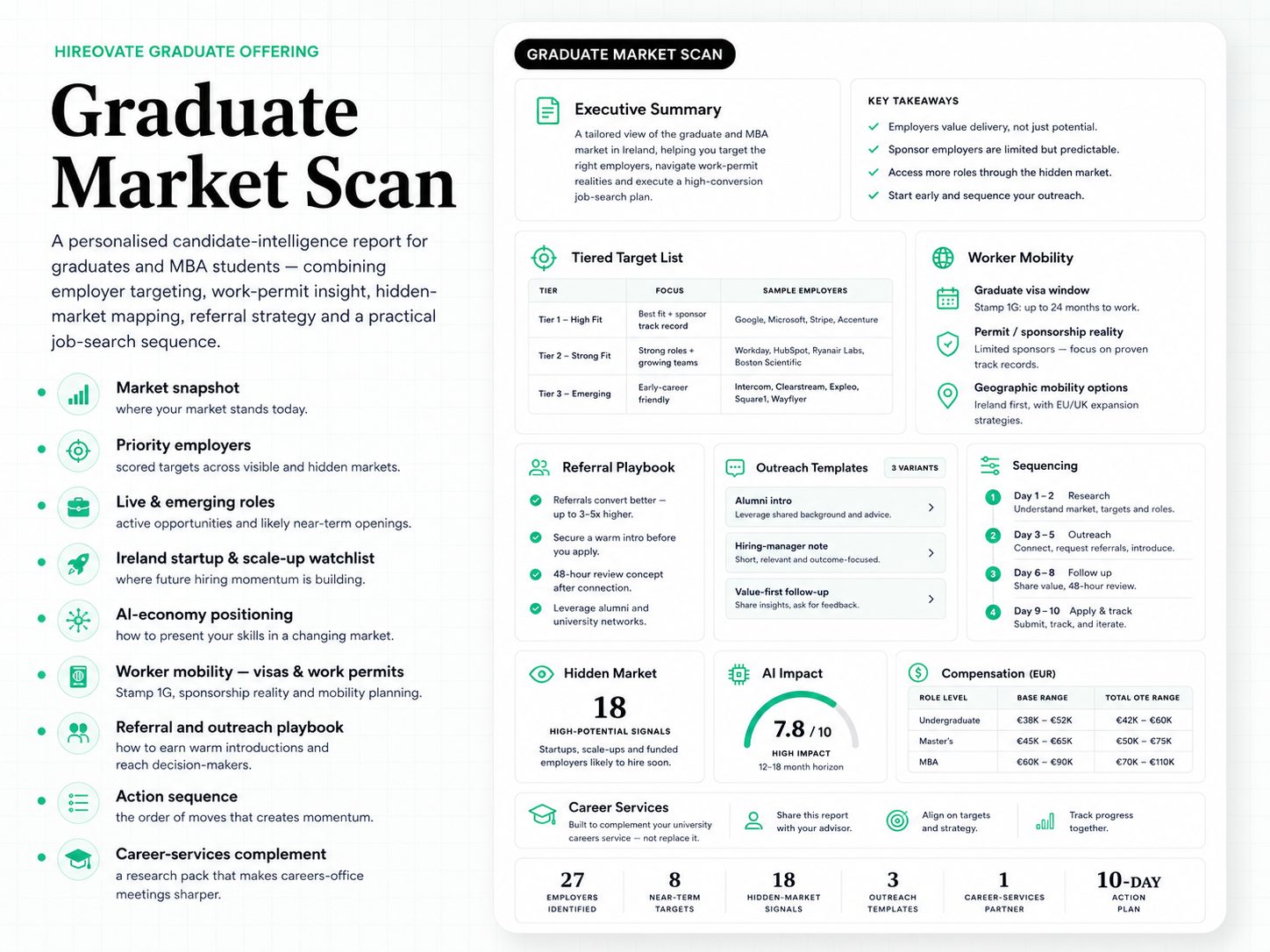
What your careers team receives
The cohort report covers
Why it matters to you
Produced once per cohort from a shared data pack, then amortised across every student's individual scan.
How we work with institutions
Four ways to bring market intelligence into your careers service, depending on how your programmes are structured.
A single cohort
One programme, one term. The full sequence — briefing, cohort report, individual Market Scans and the AI Career Readiness Training Day — delivered to a defined group. The most common starting point.
Embedded in a programme
Market intelligence built into an MBA, Masters or specialist postgraduate course as a standard component, delivered to every student on the programme each intake.
An annual careers-service partnership
Multiple cohorts across the academic year, with the cohort report refreshed each cycle and intelligence calibrated to each group's target markets.
A scoped first engagement
A smaller, defined group to prove the model before committing more widely. Includes a post-session student survey and an impact report for the careers office.
Every engagement is scoped to your cohort size, format and target markets, and confirmed in writing before anything begins. A direct engagement — no lengthy procurement.
DISCUSS YOUR COHORTCommon questions.
How is this different from the careers platforms we already use?
Careers platforms — Handshake, Bright Network, Prospects, your own vacancy portal — do one job well: they surface what has been advertised. That is genuinely useful and we don't replace it. But it means every student is working from the same list as every other student, at the same time, through the same channel. That is the queue. And the queue has become brutal: applications per advertised role have more than doubled in three years.
The Market Scan starts somewhere else entirely.
Between us we have built and led recruitment functions at Meta, LinkedIn, Microsoft, HubSpot and Apollo, across more than twenty-five years. When companies like that hire, they don't post a role and wait. A research team builds a market map first — define the universe of target companies, score them against the brief, map the org structures, identify the decision-makers by name, enrich the contact data, track the hiring signals, then run personalised outreach sequenced over weeks. That is standard operating procedure inside world-class talent functions, and it is why those companies consistently land people who never applied to anything.
Candidates have never had access to any of it. The entire apparatus points one way: companies searching for people. We have taken that process apart and rebuilt it pointing the other way — for the candidate.
Most senior roles are filled before they are ever advertised, through networks, referrals and direct approach. The same dynamic operates at graduate level, just less visibly. A company that has closed a funding round, opened a new office, expanded a function or hired a new department head is going to hire. It simply hasn't posted yet.
So we track the signals that precede hiring: funding announcements, leadership appointments, office openings, headcount trajectory, product launches, the velocity of a company's own job postings. Then we assess which of those employers would plausibly hire someone with this student's specific profile in the next two quarters. That produces a target list nobody else is looking at, reachable before the queue forms — the single biggest structural advantage available to a job seeker today.
Frontier tooling can read and cross-reference market material at a scale no research team could match. What it cannot do is tell you that a Series B company which just hired a VP of Sales will build out a junior team within four months. Or that a particular employer talks publicly about graduate hiring but converts almost entirely from its own internship pipeline. Or which "we're always looking for talent" pages are real and which are decoration. Those are pattern-recognition judgements built from years inside hiring. Without them you get a report that reads impressively and means very little. The judgement is the product. The technology is what makes it affordable enough to give a student.
We have done postgraduate study ourselves. We know what it is like to finish a good Masters with a solid CV and no real idea which forty companies to approach, who to reach inside them, or what to say. The advice available then was to apply more and network harder. Neither is a method.
We are not aware of a single provider doing this. There are many offering graduate coaching, CV clinics, psychometrics, employer-branded portals and application support — much of it good. We have not found anyone applying full executive-search market mapping at graduate level: scored target employers, named decision-makers, hidden-market signals, data enrichment, and sequenced personalised outreach. If your team knows of one, we would genuinely like to see it.
Does this replace anything our careers team does?
No, and it isn't designed to. Coaching, employer relationships, alumni networks, application support and the pastoral side of careers work sit with your team. Those depend on relationships and institutional knowledge built over years, and they are the parts we are least well placed to do.
What we add is the external market layer — the research an advisor would run for every student individually if the caseload allowed. Most advisors we speak to carry numbers that make individual market mapping impossible. That is not a skills gap, it is an arithmetic one.
In practice the report becomes a research pack the advisor works from. The conversation starts at "here are your three strongest routes and the two you should drop" rather than "what are you thinking of doing?" That is a materially better use of a thirty-minute appointment, and it frees your team for judgement and encouragement rather than desk research.
What does "personalised" actually mean here?
Not a generic report with a student's name on the cover. Each scan is built from that student's degree, prior experience, target function, target geography, work-authorisation position and stated constraints — including the employers and sectors they have explicitly ruled out, which is often the most useful input we receive.
That produces a scored target employer list ranked by realistic fit and current demand rather than brand recognition. Named decision-makers and hiring contacts at priority targets, with enriched contact data where it is available and appropriate to use. Hidden-market signals showing which employers are likely to hire before roles appear. Outreach drafted for that student and those specific people, not a template with blanks to fill. And a sequenced plan setting out who to contact, through which route, in what order, and what to do when there is no reply.
The sequencing matters more than most people expect. Most graduates send one message and stop. Professional hiring outreach assumes a multi-step sequence across several weeks, because that is what actually generates responses.
Can you support international students, including those returning home?
Yes, and this is often where we add the most value.
Most careers services are strong in their own market and necessarily thinner outside it. A student from Mumbai, Lagos, São Paulo or Shanghai studying in Dublin or London is frequently advised on the local market by default, because that is where the institutional knowledge and employer relationships sit. For a student who always intended to go home, that advice is well-meant and largely irrelevant.
We build the scan around the student's stated target market, not the location of the institution. Returning to India, the employer map, compensation benchmarks, hiring signals and outreach routes are built for India. A Brazilian student in Dublin targeting Lisbon gets Lisbon. The methodology does not change; the market does.
We also factor work authorisation into the targeting itself, flagging which employers realistically sponsor and which do not — based on observed hiring behaviour rather than published policy, which is often out of date. Where we have less depth in a particular market, we say so at scoping rather than producing a thinner report and charging the same for it.
Do you need access to our student records or systems?
No. Nothing we do touches your infrastructure, and that is a deliberate design decision rather than a limitation. No single sign-on, no student record system, no VLE connection, no API, nothing for your IT team to install or review. To begin we need a name and university email address per participating student. Everything after that is student-initiated.
On the controller relationship: your institution is controller for the cohort list. Once a student opts in and shares their own CV and career context, Hireovate becomes controller for that engagement. That split is set out in a written data-sharing agreement signed before anything begins.
We ask for CV and LinkedIn-level information only — no special-category data. All model processing runs on enterprise tiers under zero-retention, no-training terms, so student inputs never train a model. Sub-processors are named, and non-EU processing sits under Standard Contractual Clauses. Report data is deleted within thirty days of cohort close, and a student can request erasure at any point directly with us.
Your careers team sees aggregate findings by default. An individual scan reaches you only where that student opts to share it — which matters, because students are considerably more candid about what they actually want when they know their careers office is not reading it.
DPA, sub-processor list and DPIA input available on request, and we are happy to talk to your DPO before you commit rather than after.
What size cohort does this work for, and when should we run it?
Typically 25 to 50 students, though we are flexible. That range works because the cohort report draws on the group's own target markets and ambitions — below about twenty-five those patterns get thin, and individual scans make more sense on their own.
Larger cohorts are workable. Above fifty we usually split the briefing into two sessions so it stays interactive rather than becoming a lecture. The AI Career Readiness Training Day runs in groups of up to thirty by design, since it is hands-on and beyond that the facilitator cannot get round the room.
On timing: most cohorts get the strongest result when the briefing lands early — at induction or in the first weeks of term — with individual Market Scans following once students have a clearer sense of direction. It can run at any point in the year. Where a cohort is close to graduating and momentum matters more than planning, we compress the sequence and lead with the scans.
What do we get to report on afterwards?
An anonymised post-programme survey summary and an impact report for the careers office. That covers where the cohort is actually targeting — sectors, employers, geographies — set against where demand is genuinely moving, which employers showed the strongest hiring signals during the period, which skills are emerging in your students' target roles, and student-reported confidence and action progress.
Two things make this useful beyond the programme itself. It feeds employability reporting, which increasingly feeds institutional reputation and rankings. And it sharpens employer engagement: if the data shows your cohort targeting employers you hold no relationship with, that is a concrete list for your employer engagement team to work from next year.
Individual student reports stay with the student unless they choose to share them, and we encourage them to. A student who brings their report into an advisor meeting gets far more out of both — the report gives the conversation a starting point, and your team can pressure-test the targeting with knowledge of the local market that we don't have. The choice stays with the student, but the design assumes the report is a shared working document, not a private one.
How does pricing work?
Scoped per engagement rather than sold from a price list, because the variables genuinely change the cost: cohort size, how many of the four components you want, whether the briefing and training day run in person or remotely, and how many distinct target markets the individual scans need to cover.
As a general guide, a single-cohort engagement usually sits in the low tens of thousands. Where an institution runs several cohorts across the academic year, the cost per student falls considerably — the cohort data pack is built once and amortised across every scan that follows.
We are deliberately flexible on structure. Some institutions fund the whole programme centrally. Some fund the briefing and cohort report, and offer individual scans to students as a subsidised option. Some start with one programme and widen it if it works.
We are also open on commercial terms, particularly for a first engagement or a multi-year agreement. We are building this side of the business with a small number of institutions and would rather find a structure that fits your budget cycle than lose a good cohort over it.
Everything is confirmed in writing before anything begins. A direct engagement — no lengthy procurement.
Why does this exist, and why now?
Two things changed at once, and Hireovate exists in the overlap.
Hiring broke first. Applications per recruiter rose 412% between 2022 and 2025. Applications per advertised role more than doubled. Recruiters increasingly do not advertise at all, because advertising means drowning. Candidates use AI to apply, employers use AI to screen, and both sides trust the process less than they did. Graduates were hit hardest, because the advice they receive was built for a market where a good CV and a well-written application were enough.
Then the tooling changed. The market research behind an executive search — the most valuable and most expensive part of it — used to require a team of researchers and weeks of work. That is precisely why it only ever went to companies hiring senior people. Frontier language models changed that arithmetic. Not because a model does the thinking, but because it can read and cross-reference volumes of market material no research team could cover. The judgement about which signals are real and what a specific person should do still comes from decades of doing this work.
Neither piece works alone. The technology without recruitment judgement produces a confident report full of plausible nonsense. The judgement without the technology produces excellent work at a price no student could justify.
As for why the graduate end specifically: we have both been made redundant, most recently from Meta in 2023, and we have both had to make teams redundant. The support offered on both sides of that is not good enough — least of all for people at the start of their careers, who have the least market knowledge and the least room to absorb a bad year.
Finding work is not a small thing. It determines where someone can live, what they can plan for, who they can support. This calibre of intelligence has only ever gone to the people hiring VPs. We think it should reach the person applying for their first job, and we price the graduate work accordingly.
What if students don't engage?
Some will not, and we would rather say that plainly than pretend otherwise. Any provider claiming full engagement from a student cohort is either measuring something trivial or not measuring at all.
What we can control is the quality of what is offered. The briefing has to be genuinely useful in its own right — a student who attends and takes nothing further should still leave understanding how hiring now works and why applications alone are not landing. The individual report has to be specific enough that the next action is obvious rather than aspirational: this employer, this person, this route, this week.
Practically, participation is strongest where the careers team introduces the programme themselves rather than it arriving cold from an external provider. A short endorsement from someone the students already trust changes take-up considerably. We will work with you on how it is positioned, and the post-programme survey tells you honestly what landed and what did not.